
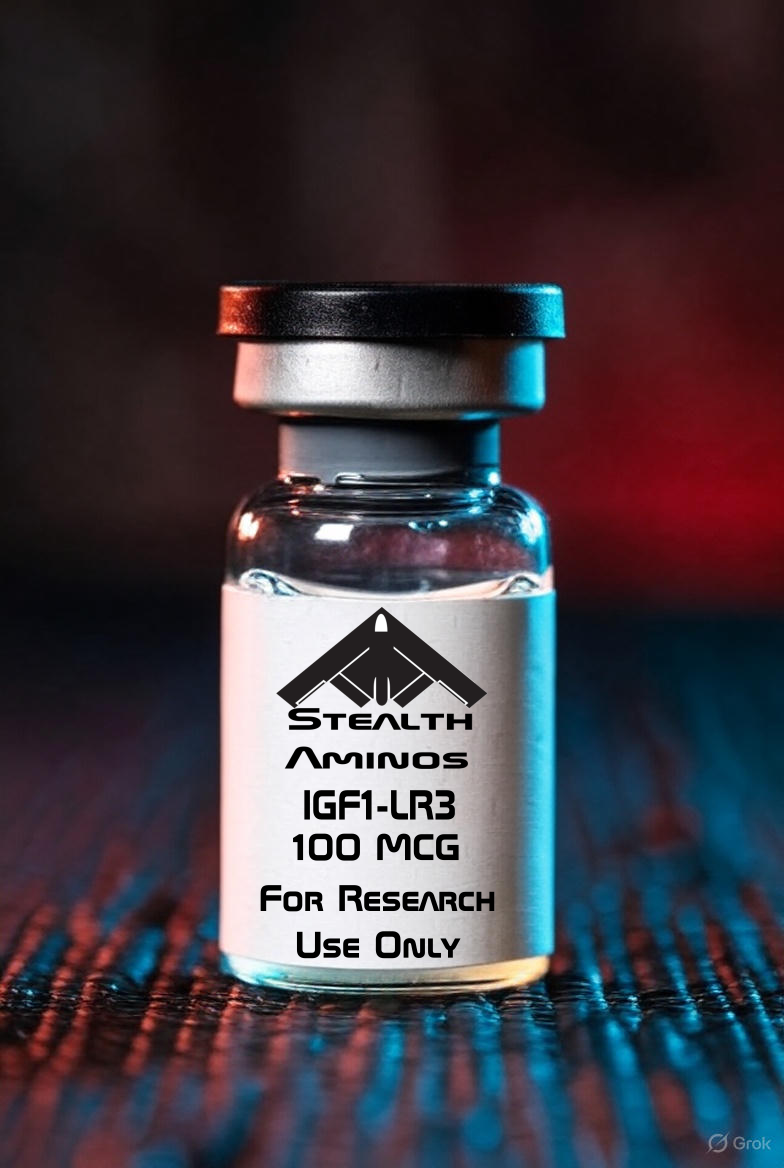
Description
GF-1 LR3 1mg Peptide Description
IGF-1 LR3 (Long Arg³ Insulin-like Growth Factor-1) is a research-grade synthetic analog of human IGF-1 supplied as a lyophilized powder (typically 1mg per vial). It is designed exclusively for in-vitro and preclinical laboratory studies on anabolic signaling, muscle hypertrophy, cartilage regeneration, and metabolic pathways.
Composition
- Active Ingredient: IGF-1 LR3 acetate
- Sequence: MFPAMPLSSL FVNGPRTLCG AELVDALQFV CGDRGFYFNK PTGYGSSSRR APQTGIVDEC CFRSCDLRRL EMYCAPLKPA KSA
- Modifications:
- Arg³ (Arginine at position 3) → resists binding to IGFBPs
- 13-amino-acid N-terminal extension → dramatically increases half-life
- Purity: ≥99% (HPLC & MS verified; third-party COA required)
- Molecular Weight: 9,117 Da
- Molecular Formula: C₄₀₀H₆₂₅N₁₁₁O₁₁₅S₉
- Form: White lyophilized powder
- Storage:
- Lyophilized: –20°C, desiccated, light-protected (stable 2+ years)
- Reconstituted: 2–8°C for up to 30 days; avoid freeze-thaw cycles
The 1mg vial supports precise micro-dosing in cell culture or animal models.
Mechanism of Action
IGF-1 LR3 binds IGF-1 receptors (IGF1R) with high affinity, activating PI3K/Akt/mTOR and MAPK/ERK pathways to promote:
- Protein synthesis (via mTORC1)
- Cell proliferation & survival (Akt-mediated anti-apoptosis)
- Glucose uptake (GLUT4 translocation)
- Collagen & ECM production (chondrocytes, fibroblasts)
Key Advantage Over Native IGF-1:
- Half-life: ~20–30 hours (vs. <10 minutes for IGF-1)
- Bioavailability: Minimal binding to IGFBP-3 → sustained systemic activity
Research Applications
| Application | Key Findings (Preclinical Models) |
|---|---|
| Muscle Hypertrophy | 15–30% increase in myofiber cross-sectional area (rodent models) |
| Cartilage & Joint Repair | Enhances chondrocyte proliferation; supports meniscal and ACL regeneration |
| Neuroprotection | Promotes neurite outgrowth; reduces apoptosis post-TBI |
| Metabolic Studies | Improves insulin sensitivity; reduces fat mass in obesity models |
| Wound Healing | Accelerates dermal repair via fibroblast activation |
Warning: Long-term use may promote hyperplasia or tumor growth in oncogene-expressing models. Contraindicated in cancer research without strict controls.
Research Protocols
- Reconstitution:
- Use 0.6% acetic acid or bacteriostatic water + 0.1% HSA/BSA
- Add 1 mL solvent → 1 mg/mL (1000 µg/mL) stock
- Gently swirl — do NOT shake (prevents denaturation)
- Aliquot and store at –80°C for long-term
- Dosing (Animal Models):
- Systemic: 10–100 µg/kg/day (subcutaneous or intramuscular)
- Local: 1–5 µg per injection site (e.g., tendon, joint)
- Cell Culture: 10–100 ng/mL in media
- Administration:
- Subcutaneous (most common)
- Intramuscular (targeted hypertrophy)
- Intra-articular (joint studies)
- Cycle: 2–6 weeks; avoid chronic exposure (>8 weeks) due to receptor desensitization risk.
Safety & Handling
- Stability: Sensitive to pH >7 and proteases; use acidic solvent
- Side Effects (Models): Hypoglycemia, organomegaly (liver, spleen), injection-site fibrosis
- Contraindications:
- Active malignancy models
- Diabetic models (risk of severe hypoglycemia)
- Pregnancy or lactation analogs
- Lab Safety: Treat as biohazard; use PPE; dispose per institutional guidelines
Reviews
There are no reviews yet.