
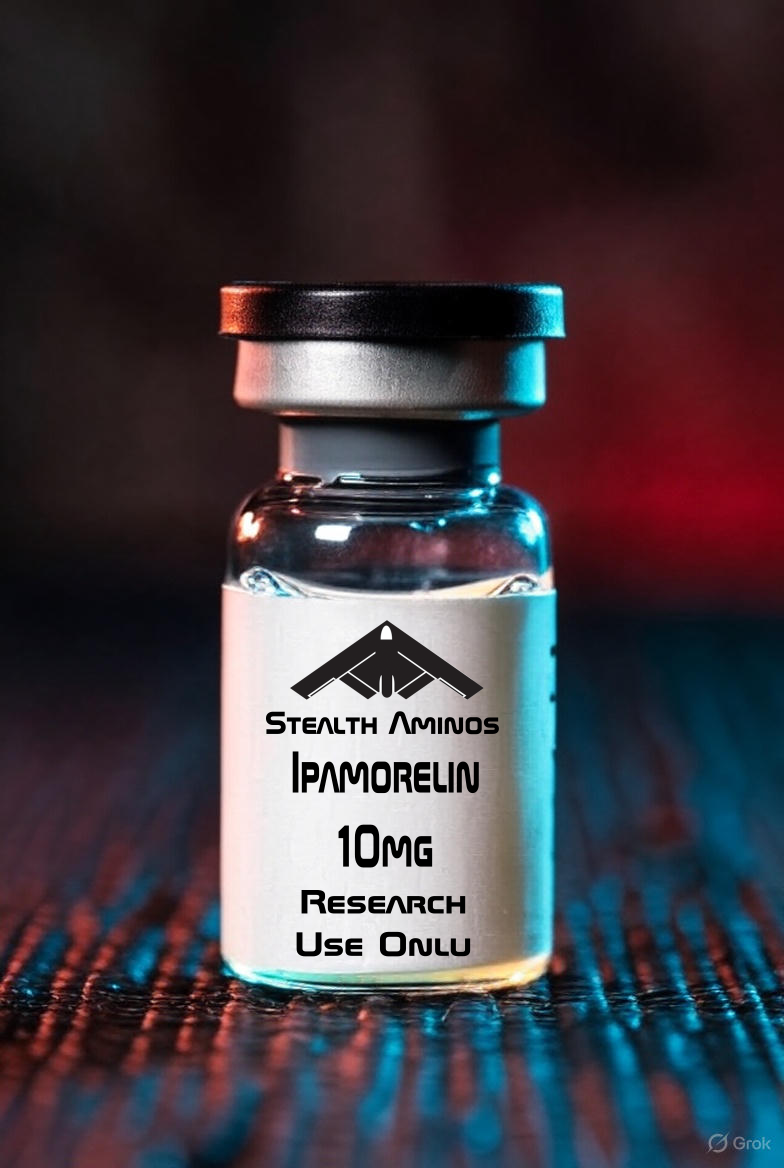
Description
Ipamorelin is a synthetic pentapeptide (5-amino-acid chain) with the sequence Aib-His-D-2-Nal-D-Phe-Lys-NH₂ (where Aib is 2-aminoisobutyric acid, a non-natural amino acid for stability). It is a selective growth hormone secretagogue (GHS) and acts as a potent agonist of the ghrelin/growth hormone secretagogue receptor (GHS-R), also known as the ghrelin receptor. Developed in the late 1990s (originally by Novo Nordisk, with key pharmacology described in 1998 studies), Ipamorelin mimics the action of ghrelin (the “hunger hormone”) to stimulate the pituitary gland to release endogenous human growth hormone (hGH) in a pulsatile, natural manner.
Unlike direct hGH injections or less selective GHRPs (e.g., GHRP-6 or GHRP-2), Ipamorelin is highly selective for GH release and does not significantly elevate levels of prolactin, cortisol, ACTH, or other hormones like FSH/LH/TSH. This “clean” profile makes it one of the most well-tolerated GH secretagogues in research and off-label use.
Ipamorelin is not FDA-approved as a drug (as of March 2026). It was previously in a regulatory gray area for compounding (e.g., listed in FDA Category 2 for certain risks like potential immunogenicity or impurities in some routes), but recent discussions (e.g., potential reclassification of select peptides in 2026) may affect availability through compounding pharmacies. It remains available primarily as a research peptide or via prescription compounding for off-label use in anti-aging, wellness, or performance contexts.
Key Features and Mechanism of Action
Ipamorelin binds to GHS-R in the hypothalamus and pituitary:
- Triggers rapid, selective pulses of GH release.
- Reduces somatostatin inhibition (a natural GH suppressor).
- Leads to elevated plasma GH and downstream IGF-1 (insulin-like growth factor-1) from the liver.
- Promotes physiological effects without broad hormonal disruption.
Half-life is short (~2 hours), so it’s often dosed multiple times daily or combined with longer-acting peptides like CJC-1295 for synergy.
Potential Benefits
From preclinical/animal studies, early human data, and off-label/clinical observations:
- Body Composition: Increases lean muscle mass/strength, enhances fat loss (via lipolysis and metabolism boost), reduces visceral fat.
- Recovery and Repair: Accelerates tissue healing, muscle recovery post-exercise/injury, supports bone density and joint health.
- Anti-Aging/Wellness: Improves skin elasticity, energy/vitality, sleep quality (aligns with natural GH pulses), immune function, and overall metabolic health.
- Other Areas: Potential for better cardiovascular support, reduced age-related decline, and adjunctive roles in performance or regenerative protocols (often stacked with CJC-1295).
Administration and Dosing
- Primary Route: Subcutaneous injection (most common/effective); reconstituted from lyophilized powder with bacteriostatic water.
- Typical Research/Compounded Dosing (from protocols and reports; not medical advice):
- 100–300 mcg per dose, 1–3 times daily (e.g., morning, post-workout, bedtime).
- Often 200–300 mcg at night to mimic natural GH pulses.
- Cycles: 8–12 weeks on, with breaks; start low to assess tolerance.
- Frequently combined with CJC-1295 (GHRH analog) for amplified, sustained GH release.
Potential Side Effects
Ipamorelin has a favorable safety profile compared to other GH secretagogues:
- Common/mild: Injection-site reactions (redness, swelling), temporary water retention, headaches, flushing, or mild hunger increase (due to ghrelin mimicry).
- Less common: Fatigue, dizziness, or numbness/tingling (rare, dose-related).
- Rare: Minimal impact on cortisol/prolactin (unlike GHRP-6/2); no major suppression of natural GH axis reported.
- Long-term data is limited; monitor IGF-1 levels to avoid excessive elevation.
Note: Evidence is strongest from animal/preclinical studies and limited human trials (e.g., GH release potency comparable to GHRP-6 but with better selectivity). Off-label use in adults for anti-aging or performance lacks large-scale RCTs. Quality varies with suppliers—use reputable sources with third-party testing.
Always consult a qualified healthcare professional before considering Ipamorelin or any peptide. Responses vary by age, baseline GH/IGF-1, and health; monitoring (e.g., bloodwork) is essential. Compared to others you’ve asked about (e.g., Sermorelin as a GHRH analog, or Epithalon for telomeres), Ipamorelin emphasizes selective, pulsatile GH stimulation with a clean side-effect profile—often preferred for body composition and recovery. Let me know if you’d like stacking ideas (e.g., with CJC-1295), comparisons, or nasal/injectable details!
Reviews
There are no reviews yet.