
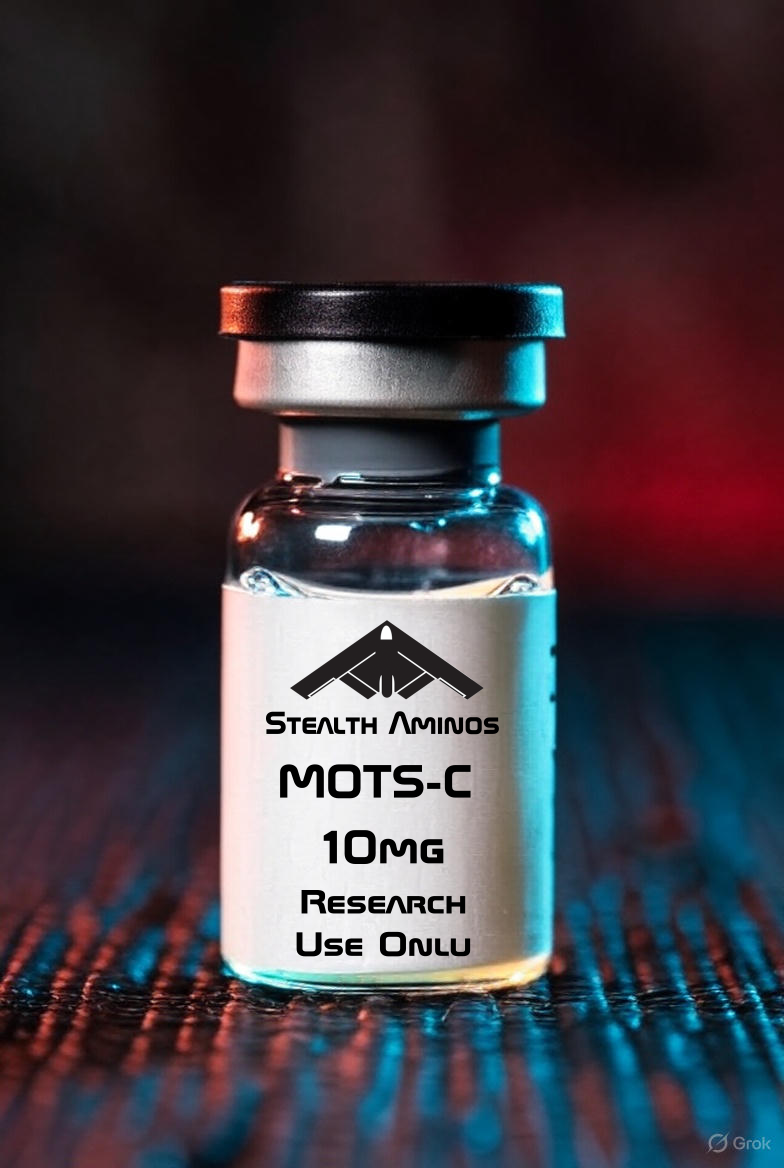
Description
What is MOTS-c?
MOTS-c (mitochondrial open reading frame of the 12S rRNA type-c) is a 16-amino-acid mitochondrial-derived peptide (MDP) encoded by a short open reading frame (sORF) in the mitochondrial 12S rRNA gene. Discovered in 2015 by researchers at the University of Southern California, it’s produced endogenously in response to metabolic stress, exercise, or energy demands, primarily in skeletal muscle, but also detectable in plasma and other tissues. Unlike nuclear-encoded peptides, MOTS-c acts as a “mitokine”—a signaling molecule from mitochondria to the nucleus—bridging cellular energy production with genomic regulation. Levels naturally decline with age, contributing to metabolic imbalances.
As of November 2025, MOTS-c remains a research chemical with no FDA approval for human use. It’s synthesized as lyophilized powder (molecular weight: 1,936 Da) for lab studies, but biohacking communities and clinics promote it off-label for metabolic and longevity applications via subcutaneous injection. Early human trials are emerging, but most data stems from animal models.
How Does It Work?
MOTS-c is upregulated during stress (e.g., exercise or fasting) and translocates from mitochondria to the nucleus, where it binds DNA motifs with antioxidant response elements (AREs) to regulate gene expression. Key mechanisms include:
- AMPK Activation: The “master switch” for energy homeostasis; MOTS-c mimics exercise by phosphorylating AMPK, promoting glucose uptake and fatty acid oxidation while inhibiting mTOR for autophagy.
- Metabolic Reprogramming: Enhances insulin signaling via the folate-AICAR-AMPK pathway, suppresses de novo lipogenesis, and boosts mitochondrial biogenesis (via PGC-1α and NRF2).
- Anti-Stress Response: Reduces ROS and inflammation by upregulating antioxidant genes (e.g., via NRF2 interaction); protects against metabolic overload in high-fat diets.
- Nuclear Signaling: Influences over 1,000 genes related to metabolism, inflammation, and aging; plasma levels rise post-exercise, acting systemically.
Administered subcutaneously (reconstituted with bacteriostatic water), effects onset in hours, with metabolic shifts in days. No oral bioavailability data; nasal forms are experimental.
Potential Benefits
Preclinical studies (mice, rats) and limited human data show MOTS-c as an “exercise mimetic,” with promise for metabolic disorders and aging. User reports on X describe “clean energy” and fat loss without jitters. Synergies noted with 5-Amino-1MQ for mitochondrial stacks.@nootropicguy
| Benefit | Description | Supporting Evidence |
|---|---|---|
| Metabolic Health & Fat Loss | Improves insulin sensitivity (up to 50% in models), enhances glucose/fatty acid metabolism; reduces obesity by 20-30% in high-fat diet mice. | Activates AMPK for fat oxidation; lowers non-fasting glucose.swolverine.com |
| Exercise Performance & Endurance | Boosts mitochondrial function and biogenesis; increases VO2 max and recovery in athletes. | Mimics exercise effects; enhances muscle glucose uptake.swolverine.com |
| Anti-Aging & Longevity | Counters age-related decline; restores metabolic balance, reduces ROS; potential neuroprotection. | Levels drop with age; improves postmenopausal risks (obesity, osteoporosis).innerbody.com |
| Cardiovascular & Diabetic Protection | Alleviates diabetic cardiomyopathy; lowers inflammation and cardiac hypertrophy. | Restores mitochondrial respiration; antioxidant defense in T2DM models.pmc.ncbi.nlm.nih.gov |
| Other | Potential bone health, cognitive enhancement, inflammation reduction; aids chronic fatigue. | Enhances memory in Aβ models; stacks for neurodegeneration.translational-medicine.biomedcentral.com |
Human trials (e.g., postmenopausal women) show modest glucose improvements; X users report 5-10% body fat drops in 4-6 weeks.@nootropicguy
Reviews
There are no reviews yet.